
FENCING BUYER GUIDES
Fence Terminology Guide
Know what the parts are called before you build your material list. Use these plain-language definitions to describe a layout, understand a product discussion and ask clearer questions.
Put a picture to the parts.
Use these visual starting points alongside the glossary below. Exact parts and compatibility depend on the fence system.
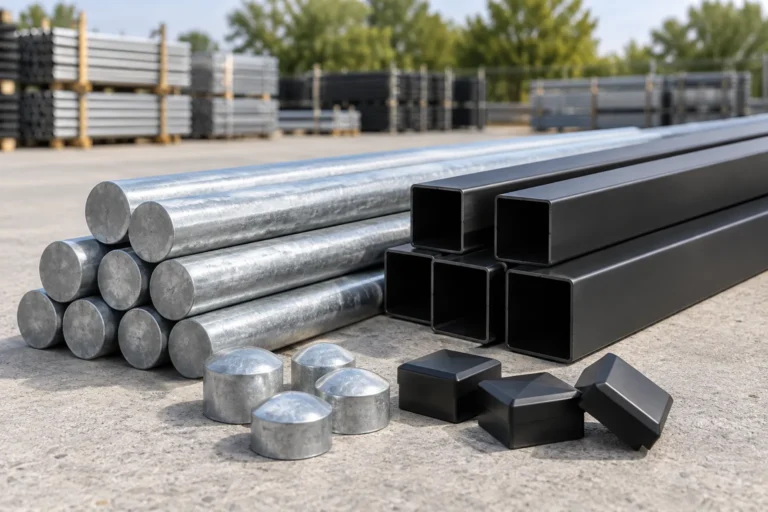
Posts & framework
Start by identifying the supports and rails in your fence system. Note the post location and dimensions when asking about a component.
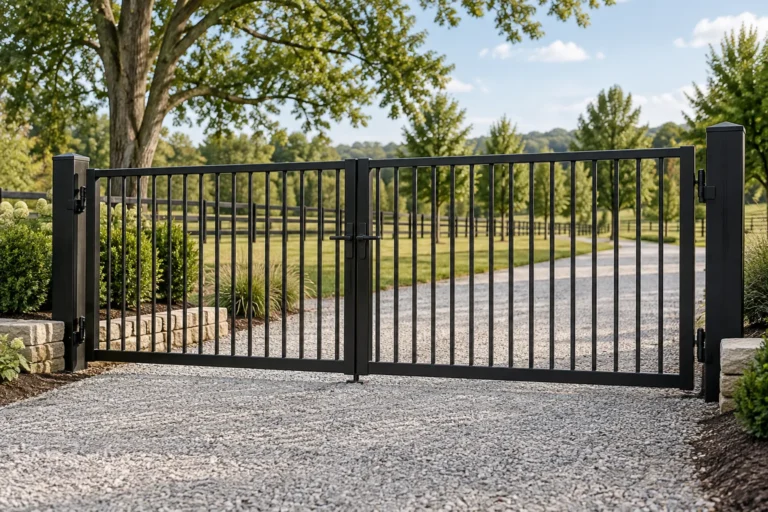
Gates & openings
Distinguish the gate itself from the clear opening needed for people, vehicles or equipment. Include the opening in your project sketch.
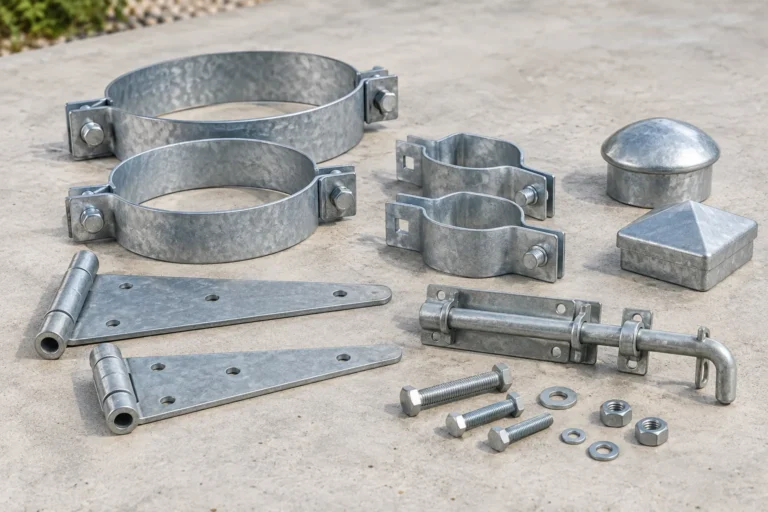
Fittings & connections
Caps, bands, hinges and latches have different jobs. For a replacement, provide a close photo and measurements rather than relying on appearance alone.
Layout and measurement terms
Fence run
A continuous section of the proposed fence route. On a planning sketch, label separate runs whenever the direction, material, height or other important condition changes.
Linear footage
The length of the fence route expressed in feet. It is a length measurement, not a panel or post count. State whether your total includes gate openings.
Takeoff / bill of materials
A takeoff develops quantities from a defined layout or drawing. A bill of materials lists the components and quantities. Label preliminary estimates so they are not mistaken for a checked order list.
Grade, stepped and racked layouts
Grade describes the ground slope. Stepped panels form successive level sections; a racked system can follow a slope within its permitted adjustment. Available approaches depend on the fence system.
Posts, rails and the fence surface
Line post
An intermediate support between terminal locations in a chain link run. Position and specification depend on the design.
Terminal post
A chain link post where fabric is secured at an end, corner, gate or designated pull point. Terminal and line posts have different roles.
Rail
A horizontal framework member. Its position and role vary by system; top, bottom and intermediate rails are not automatically included in every design.
Panel / infill
A panel is a defined fence section. Infill is the material occupying the space within or between the supporting members, such as boards, pickets or mesh.
When asking about fence posts, name their intended role and the fence system. A photograph or drawing reference can help avoid confusion.
Chain link and connection terms
Fabric and mesh
Chain link fabric is the woven wire fence surface. Mesh size describes its opening size; wire diameter describes the wire itself. These are different specifications.
Tension bar and tension band
A tension bar passes through the end of chain link fabric. Bands connect that bar to a terminal post as part of the attachment arrangement.
Brace band and rail end
A brace band is a fitting used in framework connections. A rail end receives a rail at a terminal connection. Identify the exact component rather than ordering by appearance alone.
Tie / fastener
A tie connects chain link fabric to its supporting framework. Fastener is a broader term for joining hardware. Type, material and dimensions must match the connection.
Explore chain link fencing or hardware and accessories when preparing component questions.
Gate and specification terms
Gate leaf
The moving gate section. A double gate has two leaves; record the overall opening and each leaf arrangement separately when describing the project.
Clear opening
The usable passage available for access. Do not assume a gate's advertised width equals the clear passage or required post spacing; confirm the manufacturer's dimensions.
Hinge and latch
A hinge allows a swinging gate to pivot. A latch holds it closed. Hardware selection depends on the gate and application; a latch is not automatically a security lock.
Nominal size and actual size
A nominal size is a product designation and may differ from a measured dimension. Include units and the supplier's stated dimensions when matching existing parts.
A useful inquiry names the part and its context. For example: “Please review gate-post and hinge options for the gate shown on run B.” Add measurements and any known product references rather than guessing component sizes.
References & next steps
Chain link definitions are informed by the Chain Link Fence Manufacturers Institute Product Manual. General component descriptions: The Home Depot: Fence Materials and Hardware. Slope terminology: The Home Depot: Fences on a Slope.
Terminology varies between systems. Confirm the meaning used in the specific drawing, quotation or manufacturer documentation. Next, sketch your fence layout and use the planning checklist to capture missing details.
Continue planning your fence
Fence Material Comparison Guide · How to Sketch Your Fence Layout
Material Planning Checklist · Ordering & Delivery Guide
Request project pricing